Tuesday, November 4, 2014

Taking Risks


Risks
To laugh is to risk appearing the fool,
To weep is to risk being called sentimental.
To reach out to another is to risk involvement.
To expose feelings is to risk showing your true self.
To place your ideas and your dreams before the crowd is to risk being called naive.
To love is to risk not being loved in return,
To live is to risk dying,
To hope is to risk despair,
To try is to risk failure

But risks must be taken, because the greatest risk in life is to risk nothing.
The person who risks nothing, does nothing, has nothing, is nothing, and becomes nothing.
He may avoid suffering and sorrow, but he simply cannot learn, feel, change, grow or love.
Chained by his certitude, he is a slave; he has forfeited his freedom.
Only the person who risks is truly free.
By: Janet Rand


 What’s Most Important – as most of the speakers have talked about, this is a tough question to answer… Depending on the time in my life, I most certainly would have answered this differently. Ever since Bob asked me to speak this semester, each Tuesday I’ve been reflecting on what I wanted to speak about. Right now in my life, while this may not be MOST important, taking chances and taking risks have taken me to where I am today.

In this case, the apple does not fall too far from the tree. My parents have taken a variety of risks along the way, starting with moving from the small town they grew up in near Youngstown, Ohio to the other side of the state as a young couple. My mom always reminds me of this as we discuss my sister and I living in Portland, Oregon and Boston respectfully. They too took a risk, leaving both of their families, friends, and loved ones to start a new life in Napoleon, Ohio – where I was born and raised. As a young family in Napoleon, they met friends in their apartment complex that would soon become their “chosen family”, my God parents. They found more “chosen family” in their new congregation at Emmanuel Lutheran Church and as the years continue to add up, I’ve seen them taking risks in both of their careers, some didn’t turn out as they had hoped, but they were honest with my sister and I about their decisions, these decisions have become more clear to me as I face and have faced them in my adult life.

My parents continued to take a chance, both financially and adjusting our families lifestyle by enrolling me in The Toledo Ballet when I was 15 years old after dancing locally since I was 4 years old. Toledo was at least an hour drive each way, and they shuttled me back and forth a few times a week and nightly when we were in rehearsals and performance for the Nutcracker, sometimes until midnight on a school night! I was absolutely in love with dancing, so it only made sense that would be my career. As a young adult, facing the decision to attend college, I didn’t take the road less followed, I applied for one school, The Ohio State University – I knew (or thought I knew) what my life would look like, I would go to Ohio State, major in Dance, become Britney Spears back up dancer, simple as that. I even opted out of a calculus class in my senior year of high school that would typically be required for most programs at OSU, because it wasn’t required for Dance, turns out I would eventually need to take that difficult calculus class to graduate at OSU. Long story, short – I am not currently and have never been Britney’s back up dancer. Through a series of failures, including not even getting accepted into the Ohio State school of Dance, I had to seriously reevaluate my “life plan”. During this time of reflection, I started to participate in Ohio State’s fitness classes to stay fit. And during one of these classes, I decided that it was pretty cool to teach aerobics and I also realized that I could get paid for it! Then, as you may imagine, I taught a variety of fitness classes throughout the rest of my career at OSU.

Then graduation came, what now? I was offered a full time job at a High Intensity training center for athletes in Columbus, and then shortly after an on campus interview in Cambridge (a city I’ve never visited before), I was offered a position at MIT. I talked to as many people as possible looking everywhere for the right decision. I called past professors, each of my supervisors at Dublin and Ohio State, no one could tell me exactly what I should do. I was so frustrated, confused, and the fact was, I needed to make a decision quickly. I was leaving for a 2 month back packing trip around Europe with my sister and would have to start either job immediately upon returning to the US. I think most of you know what way I went and I'm so glad I did. And a few years ago, feeling comfortable in life, on a spontaneous trip to South Beach in Miami, I met my now fiancé. He lived there, I lived here - our whole relationship was based on taking a risk on someone you loved. He knew from the day we met, that I was his soul mate so him moving across the country to be with me didn't seem like much of a risk for him, but for me, it was another time where I was uncomfortable at first but know now it was the best decision I could have ever made. 


Looking back, when I was deciding on which job to take back in 2006, I was asking myself this same question... what IS most important? This was the first time in my life when my path wasn't clear. It's funny because I haven't really thought about how difficult that decision was in a long time. For me, it was more than my "gut feeling" and in life, sometimes that's what you rely on, other times its advice from others, or maybe you lean one way because it's right for your family, and not just you. I loved Janet Rand's poem about risk, it made me really think about all of the decisions we make in our lives, from holding the door for someone on the T, or taking a job in a faraway place - each have rewards, each can be considered risky. For me, it's MOST important to find a balance between risking failure and staying comfortable. At MIT, this type of work ethic is evident every day and I think it part of the reason I love working here. Either way, the big decisions I've made and many of us make, fall somewhere on the continuum of "taking a chance" or "risking the unknown" - it may or may not pay off, but in the end - you're guaranteed to have learned something and grown as a person through it all.


Do one thing every day that scares you - Eleanor Roosevelt
Stephanie Kloos
Director of Fitness and Member Services
 MIT Recreational Sports

Reflected Light


Readings: 
And God said, “Let there be light,” and there was light.
Genesis 1:3

For God, who said, “Let light shine out of darkness,” made his light shine in our hearts to give us the light of the knowledge of God’s glory displayed in the face of Christ.
2 Corinthians 4:6

Enlightenment is like the moon reflected on the water. 
The moon does not get wet, nor is the water broken. 
Although its light is wide and great, 
The moon is reflected even in a puddle an inch wide. 
The whole moon and the entire sky 
Are reflected in one dewdrop on the grass. 

Dogen

Just as a candle cannot burn without fire, men cannot live without a spiritual life.
Buddha

God is the light of the heavens and the earth. The similitude of His light is a niche in which there is a lamp. The lamp is in a Glass, the Glass, like a glistening star, kindled from a blessed olive tree, neither of the east nor of the west, whose oil well nigh glows though no fire has touched it: light upon light.
Qur’an 24:35


Reflected Light

This year’s theme is “One Thing That is Most Important.”  That’s quite a challenge, because I can think of many things that are very important.    Love?  Purpose?  Humility?  These are all really great candidates.   Without love, St. Paul tells us, I am only a resounding gong or a clanging cymbal.  Without purpose, nothing I do really matters.   Without humility, I close the door to the kind of healthy self-criticism that can move me forward.    Should I roll the dice and just choose one of these?

Instead, I searched the sacred writings of my own faith for the phrase “the most important thing.”   I came across ‘Abdu’l-Bahá’s statement, which you just heard, that the most important thing is to polish the mirror of the heart so that it can reflect the divine light.    Interestingly enough, the piano piece that I could most easily play, given my recent lack of practice time, is the Moonlight Sonata, another reference to reflected light.   And obviously, reflected light is a pervasive metaphor that you find in all the world’s religious traditions, a sample of which I’ve shared with you.

Now I wondered, why would this be the one thing that is most important?

Perhaps it’s because this idea captures a lot of those other important things, such as love, purpose, and humility.     When we love, we are both receiving light and giving it back.   When we are humble, we acknowledge that we get our light from somewhere else and that we need to become more receptive to it.   And that leads us a purpose, to overcome attachment to the transitory things that are like smudges on the mirror.

These are all uplifting ideas, and fairly easy to discuss in the comfort of our living rooms.   But then that made me wonder, can I cite an example of someone who exemplified all this in real life?   A walker, not a talker.   I immediately thought of Mona.

Mona Mahmudnizhad grew up in Iran in the 1970’s and spent her last years living with her parents in the city of Shiraz.   An extraordinarily humble and sensitive child, she became known as the “Angel of Shiraz.”   She became so close to her schoolteachers, for example, that she would cry whenever one of them left for another position.  She had a genuine love for those around her, especially younger children who would often surround her when she arrived at school just to be with her.  When she met people that she loved, her eyes would fill with tears and she would run forward to spontaneously embrace them.  She was extraordinarily close to her father; it is said that the two could communicate with just their eyes.   She was an excellent student and had a beautiful singing voice.

Mona was a Bahá’í and her devotion to her faith was very deep.   She would often awake in the middle of the night to pray and meditate.   Among her many services to the Faith, she began at age 15 to teach Baha'i children's classes, which included the study of the great religions, developing spiritual qualities, encouraging the children to put their talents and education to the service of their fellow man, and especially learning to appreciate the oneness and diversity of the human family.

After the Islamic Revolution broke out in 1979, the persecution of the Bahá’í community in Iran went into high gear.  In 1982, when Mona was only 17, she was arrested by members of the Revolutionary Guard and sent to Seppah Prison, and later transferred to Adelabad Prison.   She, along with other Bahá’ís, endured a series of grueling interrogations, accompanied by sleep deprivation and physical torture.   The goal was to induce her to deny her faith and convert to Islam.   Several times she was told that she would be executed if she did not recant her faith and convert.   Each time, she told them that she would never deny her faith and was ready to be executed.   After eight months in prison, Mona was sent to the gallows, along with nine other Bahá’í women.   In a final attempt to break their resolve, the authorities hanged them one by one while the others were forced to watch.    Mona requested to be the last, so that she could pray for the courage of the others.


Here was a person who had truly polished the mirror of her heart and made it a brilliant reflector.      In my moments of doubt, I am rescued by her example.   What she did is the most important thing one can do.
The Light of Lights He is, in the heart of the Dark Shining eternally. Wisdom He is And Wisdom's way, and Guide of all the wise, Planted in every heart.
Bhagavad-Gita

The light of the sun becomes apparent in each object according to the capacity of that object. The difference is simply one of degree and receptivity. The stone would be a recipient only to a limited extent; another created thing might be as a mirror wherein the sun is fully reflected; but the same light shines upon both.
The most important thing is to polish the mirrors of hearts in order that they may become illumined and receptive of the divine light. One heart may possess the capacity of the polished mirror; another be covered and obscured by the dust and dross of this world. Although the same Sun is shining upon both, in the mirror which is polished, pure and sanctified you may behold the Sun in all its fullness, glory and power revealing its majesty and effulgence, but in the mirror which is rusted and obscured there is no capacity for reflection although so far as the Sun itself is concerned it is shining thereon and is neither lessened nor deprived. Therefore our duty lies in seeking to polish the mirrors of our hearts in order that we shall become reflectors of that light and recipients of the divine bounties which may be fully revealed through them.

‘Abdu’l-Bahá

Brian Aull
Baha'i Chaplain

Tuesday, October 28, 2014

The Paper is White

Excerpts from The Road by Cormac McCarthy:
The man took his hand, wheezing. You need to go on, he said. I can’t go with you. You need to keep going. You don’t know what might be down the road. We were always lucky. You’ll be lucky again. You’ll see. Just go. It’s all right.
I cant.
It’s all right. This has been a long time coming. Now it’s here. Keep going south. Do everything the way we did it.
You’re going to be okay, Papa. You have to.
No I’m not. Keep the gun with you at all times. You need to find the good guys but you can’t take any chances. No chances. Do you hear?
I want to be with you.
You cant.
You cant. You have to carry the fire.
I don’t know how to.
Yes you do.
Is it real? The fire?
Yes it is.
Where is it? I don’t know where it is.
Yes you do. It’s inside you. It was always there. I can see it.
Just take me with you. Please.
I cant.
Please, Papa.
I cant. I can’t hold my son dead in my arms. I thought I could but I cant.
You said you wouldn’t ever leave me.
I know. I’m sorry. You have my whole heart. You always did. You’re the best guy. You always were.

Do you remember that little boy [that we saw], Papa?
Yes. I remember him.
Do you think that he’s all right that little boy?
Oh yes. I think he’s all right.
Do you think he was lost?
No. I don’t think he was lost.
I’m scared that he was lost.
I think he’s all right.
But who will find him if he’s lost? Who will find the little boy?
Goodness will find the little boy. It always has. It will again.
When I first read The Road, it hit me pretty hard. That was about six years ago and at the time one of my best friends and most significant spiritual mentors was dying of cancer. My friend Andrew was 35 when he was diagnosed with stage 4 colon cancer. He was married and had three young boys. Slowly and steadily and quite painfully the cancer robbed Andrew of his strength and vitality and eventually his life. During that process, he had to face the fact that his boys would grow up without a father and there was nothing he could do about it.
I wasn’t a father at that time, but I am now. So let me tell a happier story in that regard. My daughter Lily is a boisterous and jubilant almost 3-year-old. I describe her as unbearably cute because sometimes I’m so overwhelmed with her cuteness that I’m sure my head is going to explode. In fact, I couldn’t help myself and brought this calendar from my office.
img_0036
So, everyday, I look forward to the very special moment when I get home from work. Most of the time, I am greeted with squeals of excitement and delight.
When Lily started to become more verbal I sought to engage her in conversation when I would get home. I had to think about how to engage her appropriately, on her level. I found myself asking her the question: “Lily, did you have fun today?” The more I thought about it, the more I realized that this is a actually a very important question. In a sense, maybe it’sthe most important question.
Well, this semester’s topic for Tuesday’s in the Chapel is “One thing that’s most important”. Being a parent forces you to ask yourself this question. What are the few, crucial, most important things I want to impart to my child?
When I’m asking Lily if she had fun today, I’m essentially asking, was life a positive experience for you? Did you experience the world as a joyous and good place today? This question gets at the heart of this “most important thing” that I want to teach her.  Simply stated it’s the message: this is a good world. Life, to be alive, is good. Or another way of saying it: God, if there is a God, is good.
But honestly I can find it difficult to even physically say those words “the world is good”. Because what about Andrew? being systematically and gruesomely destroyed by his own body in the prime of life? What about Andrew’s family that has been left with an unfillable void? Three boys who, point of fact, need a father and don’t have one?
Or what about all the terrible, awful evil things that take place in our world everyday? What about the children who are starving or all the wars taking place? What about all the oppression, injustice, economic inequality, religious extremism and senseless violence? These things are clearly NOT good. Not good at all.
Well, it’s these things that make it feel like an impossibly difficult task to teach Lily that the world is good. I often have a hard enough time even believing it myself. Because the world so often doesn’t appear or feel good at all.
Most of the time, life teaches us the opposite lesson, that the world is not good. That the world, or God, is not on our side. The world is going to be quite mean to us and if we’re innocent and naive about it, it’s only going to be even worse.
I know that Lily will have to learn about how much evil there is in the world. She’ll have to face kids who are mean to her, friends who betray her, people who want to hurt her or take advantage of her. She’ll have to learn that life isn’t fair, that some things break and can’t be fixed, that people she’s cares about will die. Already she’s had to learn that her parents are not always loving and sometimes raise their voices in anger.
And yet, I still want to teach her that our world (and by virtue our creator) is good, and in fact, staggeringly, shockingly, overwhelmingly good. But there’s a paradox here because I don’t want to explain away all the evil that’s so obviously present in our world. I don’t want to wave my hands and call what is not good, good.
problem of evilThis is probably the oldest and most-often-asked theological question in history. If God is good, how is there so much suffering and evil in the world? It’s so often asked because all of us feel this question. It’s not just intellectual curiosity, we feel it. Because we have all experienced that suffering and evil firsthand. At a deep level, we want, even need to knowwhy?
I don’t have a satisfying answer to that question. And I’m not sure that I’ve ever really heard one. But I do have another question that I think we should be asking. The question that’s always being asked is how is there so much evil in the world. But I think we’re actually better served by asking the question “how is there so much goodness in the world? What could possibly explain or justify this much good?”
Doesn’t the goodness need just as much of an explanation as the evil?
But for some reason it’s so much easier for us to notice the evil, the bad stuff, the stuff that hurts. I’m not a theologian, but here’s how I think of it. Let’s take the classic color scheme of white and black for good vs. evil. I think that life is like a white sheet of paper with black ink smudges on it. The paper can easily be invisible to us and all we see it the black smudges. We may examine the paper and say “there’s nothing here but nasty black stuff! nothing good at all!” We can miss the fact that the entire backdrop is white, that white is in fact the default.
post_3612_2
All that said, I have to confess that I don’t usually do a very good job at appreciating how flat out good life is. And I’m woefully under qualified to teach this lesson to Lily. Usually, I’m just trying to get through my day, just trying to keep my head above the water. I tend to bevery focused on the black spots in my life, the problems that I feel like I need to solve.
So I’ve been really impacted by some of the words of Jesus in this respect. In one of his most famous teachings, he says this.
Matthew 6:26-30
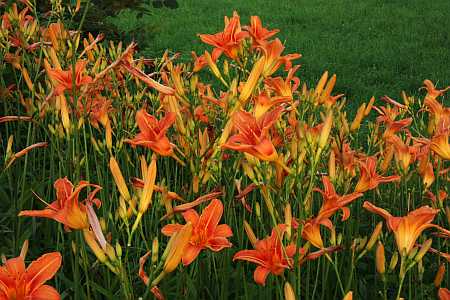
Look at the birds. They don’t plant or harvest or store food in barns, for your heavenly Father feeds them. And aren’t you far more valuable to him than they are? Can all your worries add a single moment to your life? And why worry about your clothing? Look at the lilies of the field and how they grow. They don’t work or make their clothing, yet Solomon in all his glory was not dressed as beautifully as they are. And if God cares so wonderfully for wildflowers that are here today and thrown into the fire tomorrow, he will certainly care for you. Why do you have so little faith?
So Jesus is telling people not to waste their energy on worrying about things like food and clothing. But his argument is quite interesting. I think he’s saying that there’s no need to worry because God is good and will take care of you. And do you want evidence that God is good? Well look around you. Look at anything. Look at those birds over there. Or look at these lilies over here. Evidence of God’s goodness is literally everywhere. See the backdrop of the world you live in. The paper is white.
It’s as if the goodness is there, it’s all around us, but we do actually have to look for it. Not because it’s hidden, but because it’s everywhere, it’s the fabric of our existence. We have to train our eyes, we have to learn to see it.
This teaching from Jesus has been so impactful to me and my wife Mary that this passage is actually where Lily’s name comes from. She’s named after one of the beautiful lilies of the field that can remind us how good our world and our God is.
field-lillies-horiz-small
I want to teach Lily that, yes, indeed, there is real evil in the world and we can’t ignore it. But we can’t let it distract us from the disproportionate amount of good that permeates life. We can’t let it rob us of that gift.
This is what Andrew taught me in his last days on Earth. Things deteriorated pretty quickly at the end and he was struggling with a profound sense of loss. So he’s lying there in bed with a morphine drip and he says: a month ago I was able to be outside throwing a ball with my boys. I can’t do that anymore. A week ago, I was still able to walk up and down stairs. I can’t do that anymore. A few days ago, I was still able to eat, but now I can’t do that either.
He’s thinking about all the things he can’t do anymore and feeling a crushing despair. But then he realized that there was something he could do. He was able to very carefully stand up and slowly pace back and forth next to his bed and sing a made-up 5-year-old’s song of praise to God. And that’s what he did, because, even in that moment, or maybeespecially in that moment, he was able to see how good life is and express genuine thanks to God.
Singing that song did not cure Andrew of cancer, but it did do something to lift that oppressive cloud of despair. And for a man in Andrew’s situation, that strikes me as pretty significant. That’s the power of gratitude. If the goodness of the world is knowledge that I want Lily to possess, then gratitude is the skill that I want her to develop. I think gratitude helps us to put things in perspective, it reminds us that the paper is white.
On that note, I’ll close with a quote from Thomas Merton, a catholic mystic.
“To be grateful is to recognize the Love of God in everything He has given us – and He has given us everything. Every breath we draw is a gift of His love, every moment of existence is a grace, for it brings with it immense graces from Him.
Adam Reynolds, Chaplain for the Vineyard Fellowship

Tuesday, October 21, 2014

A Good Man in Hell


Reading: 

A GOOD MAN IN HELL, ROMEO DALLAIRE AND THE RWANDA GENOCIDE, by Jerry Fowler, Staff director at the Holocaust Memorial Museum.
“Please join me in welcoming General Roméo Dallaire and Ted Koppel.
Ted Koppel: We are not going to spend this evening talking about General Dallaire. He would not have it that way. We are going to spend this evening talking about events that he observed, that he tried to prevent, that he was unsuccessful in preventing. But I want to begin this evening by focusing on a day in his life that I’m sure he remembers well. I don’t know the date or the time but basically I remember the setting: winter, park bench, and you were drunk.
Roméo Dallaire Yes.
Ted Koppel: Passed out in fact.
Roméo Dallaire: Yes, on very bad scotch.
Ted Koppel: I thought perhaps we should begin with that moment in time and with that event because there was a reason for it. Before you tell us the reason, tell us just how bad things were for you.
Roméo Dallaire: The impact of the trauma of Rwanda had physically affected my brain and had put me in a state where there was no capability left of any desire for life, any desire to even consider life. I was even debating whether I should exist as I held on my shoulders, and still today, the belief that as commander of the mission in Rwanda I had failed the Rwandans. I had failed in my duty as the UN mission commander to assist the Rwandans to be able to move to a peaceful application of democracy in a rather short period of time.
And so I entered a state that got worse with time, not better. When I did come back originally I was deputy commander of the army, and I was told don’t worry about that stuff. With time and hard work it will all dissipate and those scenes of children who were chopped up just like pieces of salami, women opened up with the fetuses laying there, elderly people dying in your arms in a mass movement of 50,000, 60,000 people in the rain in the mountains looking in your eyes and saying, “What happened? Weren’t you there? How did we end up like this?”
Falling into scenes where in a church, where we finally were able to enter—the militia had convinced the people over an extremist radio station to go there, if they felt unsafe go to the church and you will be safe by conventions of Geneva and the like—only to find out that once the place was packed, and in fact one of the churches is smaller than this and there were over 2,000 people in there, they had opened up the roof, threw a couple of grenades in, and then walked in and hacked and slashed.
Now, killing people with a machete is not efficient and it is also very tiring. So one or two hits to the majority of the people and then they would let them fester and die over two or three days.
2,000 people, including priests and nuns, were slaughtered in just one of many of the missions and churches in Rwanda.
Walking literally into a pile of bodies because there’s no way around it and feeling the cold. The cold of a dead body is not a temperature. It’s a state. And all that and the continued killing and our inability to prevent it, just to watch it. My inability to convince the international community that it should stop this incredible crime against humanity simply accumulated and with time became clearer.
Your mind with time, in fact, doesn’t erase things that are traumas. It makes them clearer. They become digitally clearer and then you are able to sit back and all of a sudden have every individual scene come to you instead of the massive blur of many scenes I saw every day.
The accumulation of the spirits that would come to you at night in the form of eyes, thousands of eyes, some mad, some simply there, and others bewildered, innocent children and adults, all that accumulated to the fact that I simply totally broke down.
The Canadian forces could not use me as a three-star general any more, as I could not command troops in operations for I was unable to handle any of the strains and responsibilities of that. So what you do with a three-star general who can’t command troops and that’s all he knows how to do, is you retire him medically. That event happened a couple months after my retirement.”

I chose to speak about my country Rwanda, because back in April this year, 2014, we did mention in the Tuesday Program in the Chapel, the remembering, the commemoration of the 20th anniversary of the Genocide of Tutsi.
Whenever you hear about Rwanda, it’s all horrible and memories of what the media, movies said about it.
I have to mention that, I was born in Zaire (now Democratic Republic of Congo) because my parents had to leave the country earlier in 1960s following political and ethnic belongs issues in Rwanda.
After the 1994 Genocide of Tutsi in Rwanda, almost 1 million people were killed and many more millions flew out of the country and most of them went to Zaire, where I was, myself and many other were the next victims, only because we’re Tutsis, or just because we look like…. It became very dangerous for us,
There was a need to help this “new Rwanda” to rebuild, then I moved to Rwanda.
Last week at MIT, we had a 15 min of All Doors Open
This morning I don’t really want to talk about death,
I want to talk about some positive fact that We, Rwandan, have made.
·      According to Forbes magazine, Rwanda is #49 Best Countries for Business
·      Looking ahead, the macroeconomic outlook points to pick-up in growth in the second half of this year as domestic demand recovers with the resumption of aid flows. For the year as a whole, economic growth is projected at 6.6 percent and 7.5 percent.
·      In 2008, Rwanda achieved a monumental milestone: the first country in the world to have a female majority in Parliament. (Women make up 18 percent of the US congress). Currently, Rwandan women hold over 55 percent of the positions in government. There ae few jobs or professions in which a woman cannot be found.
·      Donald Kaberuka, the president of the African Development Bank, is a Rwandan Citizen
·      The Rwandan Defense Forces are the elite being part of the United Nations peacekeeping, like in Haiti, Cote d’Ivoire, Mali, Liberia, Sudan… discipline and experience. Right now, they were chosen to guard the interim President of the Central African Republic.

To end my talk,
President Clinton has called the failure to intervene in Rwanda one of his biggest regrets.
And Romeo Dallaire: “Rwanda will never leave me, it’s in the pores of my body. My soul is in those hills, my spirit is with the spirits of all those people who were slaughtered and killed.

Thank you and I invite you to visit Rwanda.


~ Speaker, Claude Muhinda, Office of the Dean for Student Life ~


Reading:
I know there’s a GOD because in Rwanda I shook hands with the devil. I have seen him, I have smelled him and I have touched him. I know the devil exists and therefore I know there’s a God.
                                                                                     General Romeo Dallaire
In all my travels, I’ve never seen a country’s population more determined to forgive, and to build and succeeds than in Rwanda.
                                                                                    Rick Warren
We appreciate the true leadership that we have been blessed with in President Kagame. Thank you for your vision and most of all for peace in Rwanda. Rwanda is one of the few countries where I could live happily, invest, raise my children and enjoy…

                                                                                    Ambassador Andrew Young