Opening Reading
"But there is something in the Jewish Sabbath that is absent from most Christian Sundays: a true cessation from the rhythms of work and world, a time wholly set apart, and, perhaps above all, a sense that the point of Shabbat, the orientation of Shabbat, is toward God.
Pick up any glossy women’s magazine from the last few years and you’ll see what I mean. The Sabbath has come back into fashion, even among the most secular Americans, but the Sabbath we now embrace is a curious one. Articles abound extolling the virtues of treating yourself to a day of rest, a relaxing and leisurely visit to the spa, an extra-long bubble bath, and a glass of Chardonnay. Take a day off; the magazines urge their harried readers. Rest.
There might be something to celebrate in this revival of Sabbath, but it seems to me that there are at least two flaws in the reasoning… We could call the second problem with this current Sabbath vogue the fallacy of the direct object. Whom is the contemporary Sabbath designed to honor? Whom does it benefit? Why, the bubble-bath taker herself of course! The Bible suggests something different. In observing the Sabbath, one is both giving a gift to God and imitating Him. Exodus and Deuteronomy make this clear when they say, “Six days shall you labor and do all your work but the seventh day is a Sabbath to the Lord your God.” To the Lord your God.
Lauren Winner, Mudhouse Sabbath, pp 11-12
One of the reasons we are gathering each Tuesday is because it is important to give attention to what matters and to talk about it. It is a form of discipline. Broadening the conversation helps us grow. Our readings this morning reference Shabbat and the Christian Sabbath, both Holy days. It is not a mistake that the authors are Christian women trying hard to carve out sacred space in busy lives. Protestants seems not to do that very well.
Here at MIT we have a particularly difficult time in this regard. We are a place that seldom slows down. I was a bit taken aback the other day when my wife described me as having a very ordered life. By that she meant things were planned out in advance, scheduled. I immediately took offense thus proving her point because I have a very long list of things I do not get done and wish to do. If ordered, I am always behind.
I may be disciplined but I do not always get things done as I would wish and I seldom celebrate holy days. My style is holiday. Your know that the words have the same root and you also know as well the difference between Shabbat and the 4th of July. One celebrates us; the other points to God.
We serve our students best when we model behaviors that point beyond ourselves to the things that shape our lives. N.T. Wright has written:
"We honor and celebrate our complexity and our simplicity by continually doing five things. We tell stories. We act out rituals. We create beauty. We work in communities. We think our beliefs. No doubt you might think of more but that’s enough for the moment. In and through all these things run the threads of love and pain, fear and faith worship and doubt, the quest for justice, the thirst for spirituality, and the promise and problem of human relationship. And if there’s any such thing as “truth,” in an absolute sense, it must relate to, and make sense of, all this and more...
Take away any of these elements, as frequently happens—take away stories, rituals, beauty, work, or belief—and human life is diminished.”
From Simply Christian by N.T. Wright, pp. 49-50.
When you are always in holiday mode, you do not give attention to the substance of life. We fail to tell stories; we may act out rituals, but they are the rituals of self indulgence. Too much booze, to much food, too much sex; beauty is eroded and community destroyed by our self-indulgence. I see it most often in students who do not know that alcohol has more than one purpose, getting wasted.
Holy Days stop us in our tracks and ask of us that we think about what is finally important. I have found it touching to watch the Jimmy Carter family come to grips with their legacy as a political force. When he left the White House, it was clear that Jimmy Carter was wounded by the way things played out. His presidency was in the eyes of many a failed presidency. Carter has come to grips with what he did and did not do and seems now to feel comfortable with what he accomplished. His public wrestling with the past should give us all some comfort as we do the same. And Wright gives us a way of thinking about the process. Let us tell stories, act out rituals, create beauty and work in communities while thinking about our faith. We can never give too much attention to why we do things.
Let me offer a modest suggestion: Let each of us each week or month, tell a story, and make a record of it, that illustrates what we value. Carter spoke into a tape recorder, we may not have that luxury but if we consciously try to illustrate what is important to us over time a picture will emerge of who we are and what we value. The effort will make part of each day holy, and the sum will help us be whole.
Robert M.Randolph
Chaplain to the Institute
Closing Reading
"When I was a junior in high school, my boyfriend Herb played on the varsity basketball team. He was not the star player, however. The star player was a boy named David, who scored so many points during his four-year career that the coach retired his jersey when he graduated. This would have been remarkable under any circumstances, but it was doubly so since David did not play on Friday nights. On Friday nights, David observed the Sabbath with the rest of his family, who generously withdrew when David’s Gentile friends arrived., sweaty and defeated, after Friday night home games.
David would sit there in his kippah, openly delighted with the blow-by-blow description of the game. While the Shabbat candles still flickered….
I still remember the night someone asked David if it did not kill him to have to sit home on Friday nights while his team was getting slaughtered in the high school gymnasium. “No one makes me do this,” he said. “I’m a Jew, and Jews observe the Sabbath.” Six days a week, he said, he loved nothing more than playing basketball and he gladly gave all he had to the game. On the seventh day, he loved being a Jew more than he loved playing basketball, and he just as gladly gave all he had to the Sabbath. Sure, he felt a tug but that was the whole point. Sabbath was his chance to remember what was really real. Once three stars were visible in the Friday night sky, his identity as a Jew was more real to him than his identity as the star of our basketball team.
When I was seventeen years old, I had never heard anyone my age say anything like that before. Thirty-seven years later, I remember that living room as clearly as if I were looking at a photograph of it, with David sitting on the sofa like a rabbi teaching the rest of us the way of life…. Sabbath was not a burden for him… Sabbath was who he was.”
Barbara Brown Taylor, Leaving Church, pp. 136-137.
Monday, September 27, 2010
Sunday, September 19, 2010
New Year
We began our Tuesdays in the Chapel last week. David Thom gave us a good start. Each week we will add the chapel presentations to this site.
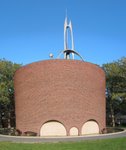
Coming to the Chapel each week offers us the opportunity to experience this sacred space. The chapel is lovely and the organ played well offers music that raises the spirit and is heavenly to hear. Occasionally Brian Aull will offer music on the piano for reflection.
When President James Killian set about to build the chapel, it was his intent that the space be used for only a few purposes: simple gatherings for baptisms, and other rites of passage, weddings,and memorial services. Private space for meditation was also important and people have told me their lives had been saved by having the chapel as a place to retreat. Killian would have been pleased that the Chapel is used as a setting for beautiful music.
As the number of people who come here grows each year, it is less common that people tell me that they did not know MIT had a Chapel. After a half-century of use it is about time!
Our gatherings on Tuesday have another benefit that is less obvious, but also important. These times of reflection give us a chance to think and write thoughtfully about important matters in our community. Last year we focused on responding to difficult times. This year the focus is on living whole (holy) lives. We need to be reminded to be thoughtful about such matters. Our gatherings give us the opportunity. It is a perfect blending of space and purpose. I hope you will take the time to join us.
Robert M. Randolph
Chaplain to the Institute
Coming to the Chapel each week offers us the opportunity to experience this sacred space. The chapel is lovely and the organ played well offers music that raises the spirit and is heavenly to hear. Occasionally Brian Aull will offer music on the piano for reflection.
When President James Killian set about to build the chapel, it was his intent that the space be used for only a few purposes: simple gatherings for baptisms, and other rites of passage, weddings,and memorial services. Private space for meditation was also important and people have told me their lives had been saved by having the chapel as a place to retreat. Killian would have been pleased that the Chapel is used as a setting for beautiful music.
As the number of people who come here grows each year, it is less common that people tell me that they did not know MIT had a Chapel. After a half-century of use it is about time!
Our gatherings on Tuesday have another benefit that is less obvious, but also important. These times of reflection give us a chance to think and write thoughtfully about important matters in our community. Last year we focused on responding to difficult times. This year the focus is on living whole (holy) lives. We need to be reminded to be thoughtful about such matters. Our gatherings give us the opportunity. It is a perfect blending of space and purpose. I hope you will take the time to join us.
Robert M. Randolph
Chaplain to the Institute


Wednesday, September 15, 2010
Beginnings
In the beginning God created the heavens and the earth. The earth was formless and void, and darkness was over the surface of the deep, and the Spirit of God was moving over the surface of the waters. Then God said, “Let there be light”; and there was light. God saw that the light was good; and God separated the light from the darkness. God called the light day, and the darkness He called night. And there was evening and there was morning, one day. Genesis 1:1-5
In the beginning was the Word, and the Word was with God, and the Word was God. He was in the beginning with God. All things came into being through Him, and apart from Him nothing came into being that has come into being. In Him was life, and the life was the Light of men. The Light shines in the darkness, and the darkness did not comprehend it. John 1:1-5
Now the LORD said to Abram,
“Go forth from your country,
And from your relatives
And from your father's house,
To the land which I will show you;
And I will make you a great nation,
And I will bless you,
And make your name great;
And so you shall be a blessing;
And I will bless those who bless you,
And the one who curses you I will curse.
And in you all the families of the earth will be blessed.”
So Abram went forth as the LORD had spoken to him; and Lot went with him. Now Abram was seventy-five years old when he departed from Haran. Abram took Sarai his wife and Lot his nephew, and all their possessions which they had accumulated, and the persons which they had acquired in Haran, and they set out for the land of Canaan; thus they came to the land of Canaan. Genesis 12:1-5
In beginning a chapel series that intends to explore living whole or holy lives, I am impressed by the thought that God would love it if we understood His wholeness, and leave our lack of wholeness to Him. Focus on Him and the effect can’t help but be good. Focus on ourselves? Nothing but misery. We hate our holes. God is at work to fill in those holes and like an expert mechanic, He’ll make you pay more if you insist on helping. When God chooses “the foolish things of the world to shame the wise, and the weak things of the world to shame the things which are strong” (1 Cor. 1:27), that means that God starts His work on us by using people in our lives whom we think that we’re better than. God’s going to use people with holes you can see a mile away to show you holes in yourself that you don’t want to see. And the only way to recover from that ugly sight? Stop gazing at yourself and start gazing at Him.
So here’s God and Abram. God wants to bless all the families of the earth through a married man who has no children because his wife is barren. Now, I am no scholar of Hebrew, or of Genesis, I’m just telling you what I see: Abram looks to me like your average good guy. I’m not sure when he got married, but let’s assume it was somewhere between the time he was 25 and 50. So at 75, he’s known for about 25 to 50 years that his wife is barren. And as we begin his story, we know of no other children by any other wives or mistresses, so one thing we can say is that he’s kept things honorable over the many years he’s been married. Has he been hopeful? I think so. I think The Lord speaks to him in answer to his own very specific prayers about his very specific situation: I don’t think God appears randomly out of the blue deciding to just bless some random guy: I think that God has chosen just the right strong and wise man to shake up.
Has Abram been frustrated about all this? That’s gotta be true too. Abram seems delighted that God is going to answer his prayers, but it seems like he thinks things are going to happen the way he wants them to happen. And how does he want things to happen? I think he wants them to happen without Sarah. See, I think it’s possible for him to have been walking in integrity, committed to fidelity in their marital relationship, but I don’t think there was any real relational harmony. My bet is that they were both terrifically discouraged over Sarah’s barrenness and they probably stopped having any kind of a relationship. That could explain why it was so easy for Abram to give up Sarah to Pharaoh, one of the first things that happens in what we know about Abram. I think that for all intensive purposes, relationally, they were divorced. In Abram’s case, I think he would be happy to move on and unite with someone else and be able to have those children that God was talking about. In Sarah’s case? She doesn’t seem to argue with the arrangement.
Well, if we read the text together, we’d see that Sarah is returned to Abram, and the relationship seems to continue to be frozen. When do things actually begin to change? When is the relationship between Abram and Sarah repaired to the extent that a child is even possible? In Genesis 20, it happens again: a king named Abimelech takes Sarah. With Pharaoh, I think Abram was just trying to speed up God’s plan. But this time, I think he’s so frustrated with things that he’s actually giving up. His name is now Abraham, and now God uses Abimelech to get Abraham to stop gazing at his and Sarah’s problems and start looking at Him, The Lord. God wants him to begin by verbalizing or as we might even say “confessing” his utterly inexcusable behavior for letting Sarah go. My impression is that in Abraham’s so called confession in Genesis 20, instead of being a man in his marriage he persists in excusing himself and blaming Sarah for all their problems. When asked why he gave up Sarah, first Abraham says, “I was afraid you’d kill me” ~ Wrong! Abe’s a first-class warrior. Second he says, “And she’s really just my sister” ~ Wrong! She’s his wife. And third he says, “And besides, it’s God’s fault I’m even out here in the first place and she agreed to this arrangement anyway.” ~ Wrong! The arrangement was a cop-out for both of them. How does God respond to Abraham’s lame confession? God has His man Abraham witness a tremendously authentic and sincere confession by a weak and desperate Abimelech as he confesses his own sin in taking Sarah by giving an enormous reparation to Abraham for taking her and then Abimelech also gives Abraham even more reparations meant to vindicate Sarah and clear her name of any wrong-doing before all men, including Abraham. That is huge! The potentially adulterous couple? They look great. Their holes are filled in! The only person left who still looks like a total schlep? Abraham.
What happens next? The best line in the whole story: “So Abraham prayed to God.” Up until now, The Lord has initiated every conversation between Him and Abe, and Genesis records every word Abraham ever says to The Lord up until this point, and he’s a talker (!), telling God this and that, even arguing with Him, but this is the first conversation He initiates with God. And it isn’t recorded: I think that there must have been some very personal words exchanged between Abraham and The Lord. I can’t prove to you how this was a turning point, but I don’t see how God could have used a man to bless the nations of the world if he hadn’t begun to deal with a broken relationship with his wife. So what happens? Abraham finally looks to The Lord and healing takes place in Abimelech’s household and children are being born again, and then healing takes place in Abraham’s household: in due time, Sarah bears Abraham a son: Isaac.
It’s been 25 years since God promised Abraham that he was going to have a family. Why’d it take so long? Well, I think that since it took Abraham and Sarah 25 years to build up animosity toward each other it was going to take 25 years before they could learn to accept one another. After running away from his problems not just once, but twice, Abraham finally looked to The Lord, and healing began. Isaac isn’t so much the miracle as much as their restored relationship is.
Today is my last day at age 49. I can barely bring myself to say the F-word that I can hardly bare to hear. A lot can happen in 50 years. The foolishness and weakness of Abraham has properly shamed me in my wisdom and strength more times than I can count. Join me in being thankful to The Lord that He loves us so much that He Himself promises to fill our holes, knowing that no one else, not our spouses, not our children, not any of our creations, not even ourselves or our best intentions, can fill our holes. We will always suffer from poor motives and poor understanding. Accept your wife and accept your life: perhaps things will go better for you. And even if your first confession sounds awful, it’s a start. God bless you on your journey.
Closing reading:
“Imagine yourself as a living house. God comes in to rebuild that house. At first, perhaps, you can understand what He is doing. He is getting the drains right and stopping the leaks in the roof and so on; you knew that those jobs needed doing and so you are not surprised. But presently He starts knocking the house about in a way that hurts abominably and does not seem to make any sense. What on earth is He up to? The explanation is that He is building quite a different house from the one you thought of - throwing out a new wing here, putting on an extra floor there, running up towers, making courtyards. You thought you were being made into a decent little cottage: but He is building a palace. He intends to come and live in it Himself.”
— C.S. Lewis (Mere Christianity)
Dave Thom
Coordinator
The Cambridge Roundtable
on Science, Art & Religion
In the beginning was the Word, and the Word was with God, and the Word was God. He was in the beginning with God. All things came into being through Him, and apart from Him nothing came into being that has come into being. In Him was life, and the life was the Light of men. The Light shines in the darkness, and the darkness did not comprehend it. John 1:1-5
Now the LORD said to Abram,
“Go forth from your country,
And from your relatives
And from your father's house,
To the land which I will show you;
And I will make you a great nation,
And I will bless you,
And make your name great;
And so you shall be a blessing;
And I will bless those who bless you,
And the one who curses you I will curse.
And in you all the families of the earth will be blessed.”
So Abram went forth as the LORD had spoken to him; and Lot went with him. Now Abram was seventy-five years old when he departed from Haran. Abram took Sarai his wife and Lot his nephew, and all their possessions which they had accumulated, and the persons which they had acquired in Haran, and they set out for the land of Canaan; thus they came to the land of Canaan. Genesis 12:1-5
In beginning a chapel series that intends to explore living whole or holy lives, I am impressed by the thought that God would love it if we understood His wholeness, and leave our lack of wholeness to Him. Focus on Him and the effect can’t help but be good. Focus on ourselves? Nothing but misery. We hate our holes. God is at work to fill in those holes and like an expert mechanic, He’ll make you pay more if you insist on helping. When God chooses “the foolish things of the world to shame the wise, and the weak things of the world to shame the things which are strong” (1 Cor. 1:27), that means that God starts His work on us by using people in our lives whom we think that we’re better than. God’s going to use people with holes you can see a mile away to show you holes in yourself that you don’t want to see. And the only way to recover from that ugly sight? Stop gazing at yourself and start gazing at Him.
So here’s God and Abram. God wants to bless all the families of the earth through a married man who has no children because his wife is barren. Now, I am no scholar of Hebrew, or of Genesis, I’m just telling you what I see: Abram looks to me like your average good guy. I’m not sure when he got married, but let’s assume it was somewhere between the time he was 25 and 50. So at 75, he’s known for about 25 to 50 years that his wife is barren. And as we begin his story, we know of no other children by any other wives or mistresses, so one thing we can say is that he’s kept things honorable over the many years he’s been married. Has he been hopeful? I think so. I think The Lord speaks to him in answer to his own very specific prayers about his very specific situation: I don’t think God appears randomly out of the blue deciding to just bless some random guy: I think that God has chosen just the right strong and wise man to shake up.
Has Abram been frustrated about all this? That’s gotta be true too. Abram seems delighted that God is going to answer his prayers, but it seems like he thinks things are going to happen the way he wants them to happen. And how does he want things to happen? I think he wants them to happen without Sarah. See, I think it’s possible for him to have been walking in integrity, committed to fidelity in their marital relationship, but I don’t think there was any real relational harmony. My bet is that they were both terrifically discouraged over Sarah’s barrenness and they probably stopped having any kind of a relationship. That could explain why it was so easy for Abram to give up Sarah to Pharaoh, one of the first things that happens in what we know about Abram. I think that for all intensive purposes, relationally, they were divorced. In Abram’s case, I think he would be happy to move on and unite with someone else and be able to have those children that God was talking about. In Sarah’s case? She doesn’t seem to argue with the arrangement.
Well, if we read the text together, we’d see that Sarah is returned to Abram, and the relationship seems to continue to be frozen. When do things actually begin to change? When is the relationship between Abram and Sarah repaired to the extent that a child is even possible? In Genesis 20, it happens again: a king named Abimelech takes Sarah. With Pharaoh, I think Abram was just trying to speed up God’s plan. But this time, I think he’s so frustrated with things that he’s actually giving up. His name is now Abraham, and now God uses Abimelech to get Abraham to stop gazing at his and Sarah’s problems and start looking at Him, The Lord. God wants him to begin by verbalizing or as we might even say “confessing” his utterly inexcusable behavior for letting Sarah go. My impression is that in Abraham’s so called confession in Genesis 20, instead of being a man in his marriage he persists in excusing himself and blaming Sarah for all their problems. When asked why he gave up Sarah, first Abraham says, “I was afraid you’d kill me” ~ Wrong! Abe’s a first-class warrior. Second he says, “And she’s really just my sister” ~ Wrong! She’s his wife. And third he says, “And besides, it’s God’s fault I’m even out here in the first place and she agreed to this arrangement anyway.” ~ Wrong! The arrangement was a cop-out for both of them. How does God respond to Abraham’s lame confession? God has His man Abraham witness a tremendously authentic and sincere confession by a weak and desperate Abimelech as he confesses his own sin in taking Sarah by giving an enormous reparation to Abraham for taking her and then Abimelech also gives Abraham even more reparations meant to vindicate Sarah and clear her name of any wrong-doing before all men, including Abraham. That is huge! The potentially adulterous couple? They look great. Their holes are filled in! The only person left who still looks like a total schlep? Abraham.
What happens next? The best line in the whole story: “So Abraham prayed to God.” Up until now, The Lord has initiated every conversation between Him and Abe, and Genesis records every word Abraham ever says to The Lord up until this point, and he’s a talker (!), telling God this and that, even arguing with Him, but this is the first conversation He initiates with God. And it isn’t recorded: I think that there must have been some very personal words exchanged between Abraham and The Lord. I can’t prove to you how this was a turning point, but I don’t see how God could have used a man to bless the nations of the world if he hadn’t begun to deal with a broken relationship with his wife. So what happens? Abraham finally looks to The Lord and healing takes place in Abimelech’s household and children are being born again, and then healing takes place in Abraham’s household: in due time, Sarah bears Abraham a son: Isaac.
It’s been 25 years since God promised Abraham that he was going to have a family. Why’d it take so long? Well, I think that since it took Abraham and Sarah 25 years to build up animosity toward each other it was going to take 25 years before they could learn to accept one another. After running away from his problems not just once, but twice, Abraham finally looked to The Lord, and healing began. Isaac isn’t so much the miracle as much as their restored relationship is.
Today is my last day at age 49. I can barely bring myself to say the F-word that I can hardly bare to hear. A lot can happen in 50 years. The foolishness and weakness of Abraham has properly shamed me in my wisdom and strength more times than I can count. Join me in being thankful to The Lord that He loves us so much that He Himself promises to fill our holes, knowing that no one else, not our spouses, not our children, not any of our creations, not even ourselves or our best intentions, can fill our holes. We will always suffer from poor motives and poor understanding. Accept your wife and accept your life: perhaps things will go better for you. And even if your first confession sounds awful, it’s a start. God bless you on your journey.
Closing reading:
“Imagine yourself as a living house. God comes in to rebuild that house. At first, perhaps, you can understand what He is doing. He is getting the drains right and stopping the leaks in the roof and so on; you knew that those jobs needed doing and so you are not surprised. But presently He starts knocking the house about in a way that hurts abominably and does not seem to make any sense. What on earth is He up to? The explanation is that He is building quite a different house from the one you thought of - throwing out a new wing here, putting on an extra floor there, running up towers, making courtyards. You thought you were being made into a decent little cottage: but He is building a palace. He intends to come and live in it Himself.”
— C.S. Lewis (Mere Christianity)
Dave Thom
Coordinator
The Cambridge Roundtable
on Science, Art & Religion
Thursday, August 5, 2010
Remembering
Memory is a terrible thing to waste. I have just returned from Israel. It was a brief visit, but long enough to get a sense of the country and the concerns of the people. It is not Eden and the nation is not perfect. A common concern among Israelis was that their best friends, the American people and the American government, were forgetting them. Many Americans do not realize the reality that shapes Israel: 36 million Arabs, many of whom will not acknowledge their right to exist, surrounding 5.4 million Jews. That is an unknown fact for many; it is not a forgotten fact.
What has been forgotten is the Shoah, the Holocaust. Israel was founded on a wave of repulsion at what had been seen in the death camps. People remembered and acted. Today there are those who have forgotten and there are those who are intellectually challenged who think it never happened. Israel looks ahead to peace, but it also does not forget. Their neighbors remind them from time to time with rockets aimed at civilians that forgetting is perilous.
Yesterday a judge in California ruled that the ban on same sex marriage was unconstitutional. The case will continue through the court system with judges responding to the notion that the values of marriage may be shared between partners of the same sex. Today the cries of judge made law are heard. The will of the people who voted against same sex marriages was cited as of more importance than the rights of a few.
Forget that the best way to strengthen the institution of marriage is to better educate those who wish to marry about the values and virtues of the institution. Remember that Americans would not have ended racial segregation without being told to do so by those who held to higher moral standards and those who interpreted the law as serving all people in our nation. Look ahead and understand that health care for all makes us a better and healthier people. Sometimes we need to hear what needs to be done even if it pushes us beyond our comfort zone. This is especially true when there are those who play on our fears and exploit them. When folk have to resort to lies to make their point there is something terribly wrong. Just ask Shirley Sherrod.
Memory is the key. We know where we have walked and by the grace of God we have a chance to be better. Let us not forget.
What has been forgotten is the Shoah, the Holocaust. Israel was founded on a wave of repulsion at what had been seen in the death camps. People remembered and acted. Today there are those who have forgotten and there are those who are intellectually challenged who think it never happened. Israel looks ahead to peace, but it also does not forget. Their neighbors remind them from time to time with rockets aimed at civilians that forgetting is perilous.
Yesterday a judge in California ruled that the ban on same sex marriage was unconstitutional. The case will continue through the court system with judges responding to the notion that the values of marriage may be shared between partners of the same sex. Today the cries of judge made law are heard. The will of the people who voted against same sex marriages was cited as of more importance than the rights of a few.
Forget that the best way to strengthen the institution of marriage is to better educate those who wish to marry about the values and virtues of the institution. Remember that Americans would not have ended racial segregation without being told to do so by those who held to higher moral standards and those who interpreted the law as serving all people in our nation. Look ahead and understand that health care for all makes us a better and healthier people. Sometimes we need to hear what needs to be done even if it pushes us beyond our comfort zone. This is especially true when there are those who play on our fears and exploit them. When folk have to resort to lies to make their point there is something terribly wrong. Just ask Shirley Sherrod.
Memory is the key. We know where we have walked and by the grace of God we have a chance to be better. Let us not forget.
Thursday, July 1, 2010
Drink Responsibly?
Living in the land of the forever young, I try to avoid being a curmudgeon, i.e. a cantankerous person. Occasionally, however, someone needs to play the role.
As we move toward the 4th of July, I am wrestling with a sermon for Sunday. I fill a symbolic role in a local congregation, Senior Minister, in addition to my role at MIT. Once a month or so I preach. The challenge on the 4th is to say something that will be heard beyond the music of the Pops and the bluster of the day. In my hometown on the northshore one small church has opted for a Patriotic Hymn Sing. I think I know what they mean, but my cantankerous side bristles a bit. But this is not about my sermon. Nor is it my sermon.
Drunk drivers on the holidays we celebrate get our attention. Drunk driving anytime leads to tragedy as we were reminded recently in the aftermath of the defeat of the US in the World Cup. Those who sell alcohol ask us to drink responsibly. I'd like to believe they mean it. The current Bud-Light campaign makes me wonder if they really do. The end of the world? Grab a six pack and party away. The Declaration of Independence? It is better with Bud.
We at MIT know what a real concern drinking responsibly is for young adults. How do we teach moderation and self-control when we also wish to encourage passion and creativity? For Budweiser bad decisions lead to passion, some good laughs and sell more beer. Their concern, like other corporate entities of late, seems to be with the bottom line.
Here in Boston we also hear a lot about the Sam Adams Brewery and their desire to craft beer that teases the palate and complements the season. On Saturday night when I have hard conversations with small groups of students with large amounts of beer, they are not drinking Sam Adams. I think I know why. Selling a beer that complements food does not have the cachet of diminished inhibitions.
It is time to ask Budweiser if they really want to be the Goldman-Sachs of the beer industry.
Robert M. Randolph
Chaplain to the Institute
As we move toward the 4th of July, I am wrestling with a sermon for Sunday. I fill a symbolic role in a local congregation, Senior Minister, in addition to my role at MIT. Once a month or so I preach. The challenge on the 4th is to say something that will be heard beyond the music of the Pops and the bluster of the day. In my hometown on the northshore one small church has opted for a Patriotic Hymn Sing. I think I know what they mean, but my cantankerous side bristles a bit. But this is not about my sermon. Nor is it my sermon.
Drunk drivers on the holidays we celebrate get our attention. Drunk driving anytime leads to tragedy as we were reminded recently in the aftermath of the defeat of the US in the World Cup. Those who sell alcohol ask us to drink responsibly. I'd like to believe they mean it. The current Bud-Light campaign makes me wonder if they really do. The end of the world? Grab a six pack and party away. The Declaration of Independence? It is better with Bud.
We at MIT know what a real concern drinking responsibly is for young adults. How do we teach moderation and self-control when we also wish to encourage passion and creativity? For Budweiser bad decisions lead to passion, some good laughs and sell more beer. Their concern, like other corporate entities of late, seems to be with the bottom line.
Here in Boston we also hear a lot about the Sam Adams Brewery and their desire to craft beer that teases the palate and complements the season. On Saturday night when I have hard conversations with small groups of students with large amounts of beer, they are not drinking Sam Adams. I think I know why. Selling a beer that complements food does not have the cachet of diminished inhibitions.
It is time to ask Budweiser if they really want to be the Goldman-Sachs of the beer industry.
Robert M. Randolph
Chaplain to the Institute
Saturday, June 5, 2010
Invocation for MIT Graduation
MIT
Almighty God, known by many names, called by many voices,
we invoke your presence with us on this day of celebration.
We celebrate the accomplishments of students who have learned and grown as they have longed for this moment.
We celebrate the accomplishments of families who have supported their sons and daughters in ways that transcend the checks to the bursar.
We celebrate the accomplishments that are the result of teachers who went beyond expectations of peers and demanded the best of the students in their care who did not know how good they could be.
We celebrate the accomplishments made possible by mentors who led by example; of spouses who held up tired arms and encouraged flagging spirits, of children who waited.
In these hard days when we are reminded often of what we cannot do, help us to remember what we have done. Let angry words not be our mantra, but rather words of celebration, words of joy and words of hope. Tomorrow will be better because of what we celebrate today!
This is our prayer,
Amen
Almighty God, known by many names, called by many voices,
we invoke your presence with us on this day of celebration.
We celebrate the accomplishments of students who have learned and grown as they have longed for this moment.
We celebrate the accomplishments of families who have supported their sons and daughters in ways that transcend the checks to the bursar.
We celebrate the accomplishments that are the result of teachers who went beyond expectations of peers and demanded the best of the students in their care who did not know how good they could be.
We celebrate the accomplishments made possible by mentors who led by example; of spouses who held up tired arms and encouraged flagging spirits, of children who waited.
In these hard days when we are reminded often of what we cannot do, help us to remember what we have done. Let angry words not be our mantra, but rather words of celebration, words of joy and words of hope. Tomorrow will be better because of what we celebrate today!
This is our prayer,
Amen
Wednesday, May 26, 2010
thoughts from the Koran
Assalamu alaykum=peace be with you, an Islamic greeting in Arabic.
I am truly delighted to be among the believers of God. The Islamic scripture Qur’an says, “Do not despair of solace from God. No one despairs of solace from Allah except for people who do not believe. (Surah, ie. Chapter Yusuf, no. 87). In these stressful times, I find the particular passage from the Qur’an as a source of strength for us all. As we approach Mothers’ Day, I am thinking of a Hadith.
saying of the Prophet Muhammad. It says: “Paradise lies under the feet of mothers.” I am sure all believers will agree that mothers deserve our love, respect, and admiration.
Omar Khalidi
I am truly delighted to be among the believers of God. The Islamic scripture Qur’an says, “Do not despair of solace from God. No one despairs of solace from Allah except for people who do not believe. (Surah, ie. Chapter Yusuf, no. 87). In these stressful times, I find the particular passage from the Qur’an as a source of strength for us all. As we approach Mothers’ Day, I am thinking of a Hadith.
saying of the Prophet Muhammad. It says: “Paradise lies under the feet of mothers.” I am sure all believers will agree that mothers deserve our love, respect, and admiration.
Omar Khalidi
Subscribe to:
Posts (Atom)