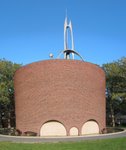
Last Sunday evening the Chaplain to the Institute was installed. Several have said that they did not know what to expect and were pleasantly surprised. Those who did not know what to expect and were disappointed have not talked with me. If you would like to view the proceedings you may do so at
http://techtv.mit.edu/file/326/
At the Chaplain's Seminar on October 1, speakers dealt with the challenge of Samuel Huntington's clash of cultures thesis. Dr. Richard Hughes of Messiah College offered this conclusion:
Ironically, no one has made that case any more strongly than Samuel Huntington who cites approvingly the Venetian nationalist demagogue in Michael Didbin’s novel, Dead Lagoon. “There can be no true friends without true enemies,” the Venetian says. “Unless we hate what we are not, we cannot love what we are. These are the old truths we are painfully rediscovering after a century and more of sentimental cant.” In response to this affirmation, Samuel Huntington comments, “The unfortunate truth in these old truths cannot be ignored by statesmen and scholars. For people seeking identity and reinventing ethnicity, enemies are essential.”
Maybe so, but if there is any chance that Christian leaders might lead us toward peace and not toward war and conflict, those are precisely the assumptions they must challenge. Put another way, so long as Christian leaders assume that the imperial vision is both normative and true to life, and so long as they assume that the biblical vision of the kingdom of God is finally unworkable and irrelevant, there is no chance that they will offer leadership any different from the standard imperial leadership that has driven the world for centuries.
The truth is, Christian leaders of tomorrow must embrace a new paradigm for thinking about war and peace—a paradigm that is at the very same time an ancient paradigm, embraced both by Jesus and the early church.
Let me offer just one example of what that paradigm might mean. David Lipscomb was a religious leader in the American South from the Civil War through the early twentieth century. After the Civil War, he reflected on his own role during that conflict. “In the beginning of the late strife that so fearfully desolated our country, much was said about ‘our enemies.’ I protested constantly that I had not a single enemy, and was not an enemy to a single man North of the Ohio River.” Lipscomb’s statement stands in stark contrast with Samuel P. Huntington’s assumption that “there can be no true friends without true enemies” and that, when all is said and done, “enemies are essential.”
And when, in 1896, the United States employed the Monroe Doctrine to threaten war against Great Britain, Lipscomb offered leadership on other grounds. He wrote, “When the leading lights among politicians begin to advocate war in defense of the Monroe doctrine, it is high time . . . to commence preaching peace on earth and good will among men in defense of the doctrine of the Sermon on the Mount.”
You may object that what I have said in this presentation is far too visionary to be workable. But religious leaders are not called to embrace and sanction imperial assumptions. They are called, instead, to offer a vision grounded in their religious traditions. And deep in the Christian tradition lays a vision for peace on earth and good will among all humankind—a vision that has rarely been tried. This is the vision I commend to Christian leaders of the future, and a vision I commend to you today as we celebrate the installation of Robert M. Randolph as the first Chaplain of MIT.
Dr. Ronald B. Sobel, Senior Rabbi Emeritus from Temple Emanu-El in New York City and Suheil Laher, Muslim Chaplain also offered their perspectives. Excerpts will appear here in the coming weeks.
Friday, October 5, 2007
Friday, September 28, 2007
On not being afraid.
Star Simpson a junior here at MIT got her 15 minutes of fame last week. On the front page of the Boston Herald she looked bemused. Those who know her say she feels like she was hit by a train. Wearing a name tag from an event at the Media Lab, she went to Logan Airport to meet a friend, a circuit board was on her sweat shirt with wires dangling. A few unanswered questions later she found herself the object of more attention than she wished. "So smart, so dumb." lamented a critic. Others took shots at MIT where they perceive a permissive environment that abandons commonsense. We all breathed a sigh of relief when the attention shifted to John Harvard dressed to participate in Halo 3.
I have been watching Ken Burns' The War. I am old enough to remember the times, to have felt the emotions and to have celebrated VJ Day. Watching the documentary, listening to contemporary conversations of those among the Greatest Generation, I have been reminded that we are often only a step away from high heroics and mind-numbing villany. The stories of the Japanese Americans who fought in Italy while their families were in camps behind barbed wire remind of both extremes.
Victor Frankl once remarked that being human means to be conscious and to be responsible. Now is the time to be responsible. What happened on 9/11 has made us fearful and some have used that fear to advance agendas and create climates where a college girl feared for her life in an American airport. Others decry entrepreneurial creativity as a luxury we cannot afford.
I worry more about a time where fear is our first emotion, and our default response to the unknown. That does not leave much room for building a better world and that is, what we are about. Star should have known better. So should we. Churches, synagogues, mosques and universities are meaning making communities. We offer a context in which we take the stuff of living and make sense of it. Now at the end of an eventful week we have a lot to work with. I pray we will do our
work well.
An Invitation
Join us at 5:30 PM on Sunday (September 30) for the Installation of the Chaplain to the Institute.
On Monday (October 1) at 4 PM in the Wong Auditorium (E-51) you are invited to join us for The Chaplain's Seminar where we will reflect on Religious Leadership in the 21st Century: How Are We to Avoid a Clash of Cultures? The Seminar will feature Dr. Ronald B. Sobel, Rabbi Emeritus Temple Emanu-el, NYC, Dr. Richard Hughes, Messiah College, Dr. Elizabeth Parsons, Quincy College, The Venerable Tenzin Priyadarshi, Buddhist Chaplain at MIT and Suheil Laher, Muslim Chaplain at MIT.
Robert M. Randolph
Chaplain to the Institute
I have been watching Ken Burns' The War. I am old enough to remember the times, to have felt the emotions and to have celebrated VJ Day. Watching the documentary, listening to contemporary conversations of those among the Greatest Generation, I have been reminded that we are often only a step away from high heroics and mind-numbing villany. The stories of the Japanese Americans who fought in Italy while their families were in camps behind barbed wire remind of both extremes.
Victor Frankl once remarked that being human means to be conscious and to be responsible. Now is the time to be responsible. What happened on 9/11 has made us fearful and some have used that fear to advance agendas and create climates where a college girl feared for her life in an American airport. Others decry entrepreneurial creativity as a luxury we cannot afford.
I worry more about a time where fear is our first emotion, and our default response to the unknown. That does not leave much room for building a better world and that is, what we are about. Star should have known better. So should we. Churches, synagogues, mosques and universities are meaning making communities. We offer a context in which we take the stuff of living and make sense of it. Now at the end of an eventful week we have a lot to work with. I pray we will do our
work well.
An Invitation
Join us at 5:30 PM on Sunday (September 30) for the Installation of the Chaplain to the Institute.
On Monday (October 1) at 4 PM in the Wong Auditorium (E-51) you are invited to join us for The Chaplain's Seminar where we will reflect on Religious Leadership in the 21st Century: How Are We to Avoid a Clash of Cultures? The Seminar will feature Dr. Ronald B. Sobel, Rabbi Emeritus Temple Emanu-el, NYC, Dr. Richard Hughes, Messiah College, Dr. Elizabeth Parsons, Quincy College, The Venerable Tenzin Priyadarshi, Buddhist Chaplain at MIT and Suheil Laher, Muslim Chaplain at MIT.
Robert M. Randolph
Chaplain to the Institute


Thursday, September 20, 2007
Changes
This morning as I finished my run around the Charles River change was all around me. I obviously have changed. My arms are smaller, a bit flabby. I run slower and my joints creak. When I mention that I run I am told I am foolish and need to consider low impact exercise. It used to be that when I talked of running folks thought it was cool. “You ran how far?” they would ask.
The trees are beginning to change; the air is a bit more brisk than in August. My fellow runners are different too. Used to be all men, but now from my perspective there is additional beauty to be seen. Women outnumber men 3-2 or thereabouts. I don’t count. I guess that is not a surprise now that there are more women than men in the college/university. Most must run and in taking care of themselves they once again outdo the men. I run because it allows me to think, to put things together in helpful ways. These days that has become more difficult. Some things don’t change.
Next week (September 30th) we will install the first Chaplain to the Institute. It marks a change at MIT. Attention is being paid here to the role of religion in the human experience. I will be Chaplain to the whole Institute, believers, non-believers, the uncertain. This change reflects recognition that religion contrary to expectations seems to be more important today than ever in our world lurking as it does on the edges of both conflict and comfort.
Last Sunday, The Boston Globe announced another wave of change. More young adults are declaring themselves non-religious. I might have done the same if I had to suffer through the smug God talk of many politicians without the perspective of age. We are always a bit behind the curve. I expect that before the godless become a majority another trend will develop. In any case, on Saturday at the close of Yom Kippur, Muslims observing Ramadan and Jews who have observed a Day of Atonement will break fast together on our campus. In this world of conflict and tension, that is a change for the good which we all should celebrate. Still today something good can come out of Jerusalem.
Robert M. Randolph
This morning as I finished my run around the Charles River change was all around me. I obviously have changed. My arms are smaller, a bit flabby. I run slower and my joints creak. When I mention that I run I am told I am foolish and need to consider low impact exercise. It used to be that when I talked of running folks thought it was cool. “You ran how far?” they would ask.
The trees are beginning to change; the air is a bit more brisk than in August. My fellow runners are different too. Used to be all men, but now from my perspective there is additional beauty to be seen. Women outnumber men 3-2 or thereabouts. I don’t count. I guess that is not a surprise now that there are more women than men in the college/university. Most must run and in taking care of themselves they once again outdo the men. I run because it allows me to think, to put things together in helpful ways. These days that has become more difficult. Some things don’t change.
Next week (September 30th) we will install the first Chaplain to the Institute. It marks a change at MIT. Attention is being paid here to the role of religion in the human experience. I will be Chaplain to the whole Institute, believers, non-believers, the uncertain. This change reflects recognition that religion contrary to expectations seems to be more important today than ever in our world lurking as it does on the edges of both conflict and comfort.
Last Sunday, The Boston Globe announced another wave of change. More young adults are declaring themselves non-religious. I might have done the same if I had to suffer through the smug God talk of many politicians without the perspective of age. We are always a bit behind the curve. I expect that before the godless become a majority another trend will develop. In any case, on Saturday at the close of Yom Kippur, Muslims observing Ramadan and Jews who have observed a Day of Atonement will break fast together on our campus. In this world of conflict and tension, that is a change for the good which we all should celebrate. Still today something good can come out of Jerusalem.
Robert M. Randolph
Friday, September 7, 2007
New Beginning
Just over a week ago the Class of 2011 arrived on campus. They are an eclectic lot, bright eyed and able. The mood on campus is electric; the Chaplains hosted a PB&J Bash inviting those interested in their ministries to drop by and get acquainted. The annual Duck Float, close now to a tradition, invited frosh to choose a yellow duck from those floating in the moat. Over 500 were taken. Having your own yellow ducky might not have the cachet it once had, but they do get attention.
Johanna Kiefner, the Lutheran Chaplain for the last seven years, leaves this month to complete her Social Work degree. she has been a valuable, caring member of our community. Her interim replacement, Diane Ranson, has the challenge of following a compassionate professional. At the same time, we are welcoming back Amy McCreath from a summer sabbatical. She and Diane will lead this year's iteration of the Lutheran-Episcopal Ministry. Known at LEM, the program has a storied history here at MIT.
While we celebrate what Johanna has done and welcome Diane to our community, we also must deal with the absence in our midst of James Albrecht '08. A former President of Baker House, James died in New York City this summer. He was a campus leader, a math major with enormous talent and intellect, and a friend to many. Services have been held in his home town, but on campus we are just now back so today led by Fr. Richard Clancy we celebrated James' life.
Our year begins celebrating the promise of a diverse and talented new class. We say good by to a good friend and caring pastor who knew how to foster and support faith in both thought and action. As well we come together to grieve and to begin to heal. It is a new year and a new beginning, but already we are reminded of the fragility of life and friendship and the value of a caring community. It is ever so.
blessings,
Robert M. Randolph
Johanna Kiefner, the Lutheran Chaplain for the last seven years, leaves this month to complete her Social Work degree. she has been a valuable, caring member of our community. Her interim replacement, Diane Ranson, has the challenge of following a compassionate professional. At the same time, we are welcoming back Amy McCreath from a summer sabbatical. She and Diane will lead this year's iteration of the Lutheran-Episcopal Ministry. Known at LEM, the program has a storied history here at MIT.
While we celebrate what Johanna has done and welcome Diane to our community, we also must deal with the absence in our midst of James Albrecht '08. A former President of Baker House, James died in New York City this summer. He was a campus leader, a math major with enormous talent and intellect, and a friend to many. Services have been held in his home town, but on campus we are just now back so today led by Fr. Richard Clancy we celebrated James' life.
Our year begins celebrating the promise of a diverse and talented new class. We say good by to a good friend and caring pastor who knew how to foster and support faith in both thought and action. As well we come together to grieve and to begin to heal. It is a new year and a new beginning, but already we are reminded of the fragility of life and friendship and the value of a caring community. It is ever so.
blessings,
Robert M. Randolph
Friday, August 24, 2007
From the Chaplain to the Institute
Dear Friends:
In 1955 when Kresge Auditorium and The Chapel were opened there was a good deal of conversation at MIT about having a Dean of the Chapel on the model of Duke University. The names tossed about in good MIT fashion were noteworthy. Ultimately, however, nothing came of it. When President James Killian left Cambridge to become Science Advisor to President Eisenhower, the notion died quietly. In the subsequent half-century there were always chaplains on campus serving established religious traditions. They were an outstanding group. Mike Bloy, John Crocker, Scott Paradise, Bernard Campbell and Jessica Crist come to mind.
At the same time, the Institute was well served by Dean Robert Holden, an ordained Unitarian minister, who was de facto chaplain to the Institute. He kept an eye on the religious communities on campus and on just about everything else that went on here. He was proud of the chapel and a quarter century after his retirement, there are those who call his name with a bit of reverence. In 1981, I moved onto campus with my family and became the Dean in Residence trying to fill the large shoes that Bob Holden left behind.
Now it is a new day and Dean Larry Benedict approached me last fall to ask if I would take responsibility for religious life on campus. After 28 years of service as a Dean dealing with often difficult situations, to be challenged by this new role was very attractive. On January 1, 2007 I became the first official Chaplain to the Institute.
The title is intentional. The role will serve the entire community: students, staff, faculty and research staff. In addition to the symbolism, the goal for the Chaplain to the Institute is to foster dialogue across religious boundaries while at the same time supporting the communities of faith that exist at MIT. I am an ordained Christian minister, but my role is not to advocate for one community or another, but to help create a wider community that has room for all shades of belief and unbelief, a community that nurtures and supports the healthy development of interior life during the university years. It is a daunting task.
This blog will appear regularly. On my web site information about upcoming events and activities will appear also. There will be links to articles about different ministries on campus. MIT remains a vital community drawing the best from all of us. We covet your support and encouragement.
Dr. Robert M. Randolph
Chaplain to the Institute
In 1955 when Kresge Auditorium and The Chapel were opened there was a good deal of conversation at MIT about having a Dean of the Chapel on the model of Duke University. The names tossed about in good MIT fashion were noteworthy. Ultimately, however, nothing came of it. When President James Killian left Cambridge to become Science Advisor to President Eisenhower, the notion died quietly. In the subsequent half-century there were always chaplains on campus serving established religious traditions. They were an outstanding group. Mike Bloy, John Crocker, Scott Paradise, Bernard Campbell and Jessica Crist come to mind.
At the same time, the Institute was well served by Dean Robert Holden, an ordained Unitarian minister, who was de facto chaplain to the Institute. He kept an eye on the religious communities on campus and on just about everything else that went on here. He was proud of the chapel and a quarter century after his retirement, there are those who call his name with a bit of reverence. In 1981, I moved onto campus with my family and became the Dean in Residence trying to fill the large shoes that Bob Holden left behind.
Now it is a new day and Dean Larry Benedict approached me last fall to ask if I would take responsibility for religious life on campus. After 28 years of service as a Dean dealing with often difficult situations, to be challenged by this new role was very attractive. On January 1, 2007 I became the first official Chaplain to the Institute.
The title is intentional. The role will serve the entire community: students, staff, faculty and research staff. In addition to the symbolism, the goal for the Chaplain to the Institute is to foster dialogue across religious boundaries while at the same time supporting the communities of faith that exist at MIT. I am an ordained Christian minister, but my role is not to advocate for one community or another, but to help create a wider community that has room for all shades of belief and unbelief, a community that nurtures and supports the healthy development of interior life during the university years. It is a daunting task.
This blog will appear regularly. On my web site information about upcoming events and activities will appear also. There will be links to articles about different ministries on campus. MIT remains a vital community drawing the best from all of us. We covet your support and encouragement.
Dr. Robert M. Randolph
Chaplain to the Institute
Subscribe to:
Posts (Atom)